
Author Guidelines
A. FOCUS & SCOPE
JAUS strictly publishes manuscripts related to sports within the Higher Education/University context, particularly in the ASEAN region. Manuscripts outside this scope (e.g., professional sports without university linkage) will be rejected. The scope includes:
- Sport Management & Policy in Higher Education: Governance of university sports boards, funding models, facility management, and strategic policies.
- University Sports Events & Tourism: Management of events like ASEAN University Games (AUG), Universiade, National or Regional University Games, and their impact on sports tourism.
- Physical Education Curriculum in Higher Education: Curriculum development, teaching models, and assessment in Physical Education Teacher Education (PETE) programs.
B. SUBMISSION POLICY
- Online Submission: All manuscripts must be submitted online via the OJS Website. We do not accept submissions via email.
- Publication Fee: JAUS is fully funded by PT Smart Motion Technology and Education to support open science. There is NO SUBMISSION FEE and NO PUBLICATION FEE (Free of Charge) for all accepted articles.
- International Collaboration: Articles co-authored by researchers from at least two different countries will be given High Priority in the review process and fast-track publication.
C. AUTHORSHIP & ETHICS
- Author Limit: Maximum number of authors is 10 persons.
- Contribution Statement: For manuscripts with more than 4 authors, a "Contribution Statement" must be included at the end of the manuscript (specifying who did the conceptualization, data collection, analysis, and writing).
- Conflict of Interest: Authors must declare any potential conflict of interest regarding the funding or execution of the research.
- Organizational Consent: For Case Studies involving specific organizations (e.g., Federations, Universities) or Events (e.g., AUG, SEA Games), authors must declare that they have obtained permission to collect data from the respective organization.
D. ARTICLE TYPES
JAUS accepts the following types of manuscripts:
- Original Research: Reports of original empirical data (e.g., Experimental Study, Ex Post Facto, Survey, or Correlational). Must follow the IMRAD structure.
- Systematic Reviews (with or without Meta-Analysis): Comprehensive review of literature using standard protocols (e.g., PRISMA). Note: We prioritize Systematic Reviews over Narrative/Simple Literature Reviews. MANDATORY use of PRISMA guidelines for the selection process. Authors may present a Narrative Synthesis or a Meta-Analysis depending on data homogeneity.
- Policy Briefs/Analysis: Critical evaluation of government or university regulations affecting university sports development
- Case Studies: Detailed analysis of a specific problem or success story in a university or sports organization (e.g., "Crisis Management in XYZ University Sports Team"). Must provide managerial/theoretical implications, not just a chronological report.
E. MANUSCRIPT FORMATTING & LAYOUT
Authors MUST use the provided MS Word Template. If writing from scratch, please adhere to these specifications:
- File Format: Microsoft Word (.doc / .docx). Authors MUST use the provided MS Word Template.
- Paper Size: A4 (21.0 x 29.7 cm).
- Margins: Top 3 cm, left 3 cm, bottom 3 cm, right 2.5 cm.
- Font: Times New Roman, 12 pt.
- Spacing:15 line spacing.
- Paragraph: First line indented by 0.5 cm. Justified text.
- Language: English (Preferred) or Indonesian.
- Length: Original research 4000-7000 words (excluding references). Systematic review up to 8000 words (excluding references).
- Plagiarism: Manuscripts with a similarity index above 20% will be rejected.
- Anonymity: To ensure a double-blind review process, the main manuscript file MUST NOT contain the authors' names and affiliations. Please submit a separate "Title Page" containing author details during the submission process.
F. SPECIFIC LAYOUT GUIDELINES
1. TABLES
a. Format: Editable text (MS Word Table Feature), NOT Images. Define all abbreviations in the table footer.
b. Style: Horizontal lines only (APA Style). No vertical lines.
c. Posisition: Nurmberedd sequentially (Table 1, Table 2). Tittle placed ABOVE the table.
d. Example:
Table 1. Descriptive Statistics of Kinematic Variables
|
Variable |
Mean (M) |
SD |
Min |
Max |
|
Approach Velocity (m/s) |
8.45 |
0.32 |
7.90 |
8.95 |
|
Knee Angle at Take-off (°) |
165.40 |
4.20 |
158.50 |
172.10 |
|
Contact Time (s) |
0.14 |
0.02 |
0.11 |
0.18 |
2. FIGURES
a. Quality: Minimum 300 DPI (High Resolution).
b. Format: JPEG, PNG, or TIFF.
c. Position: Numbered sequentially (Figure 1, Figure 2). Title placed BELOW the figure.
d. Note: Ensure charts are distinguished by patterns/shapes, not just colors, to ensure readability in black-and-white print. The PRISMA Flow Diagram must be included as Figure 1.
e. Example:
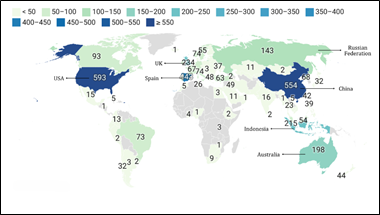
Figure 1. Distribution of Publications
G. MANUSCRIPT STRUCTURE
Select structure based on article type:
1. TYPE A: ORIGINAL RESEARCH (IMRAD)
a. Title: Concise, max 15 words.
b. Abtract: English (200-250 words). Structured implied: Objectives, Methods, Results, Conclusion.
c. Keywords: Provide 3-5 keywords (not from title), separated by semicolons (;). Avoid general terms; use specific terms relevant to the study (e.g., Motor Control; Kinematics; Early Childhood).
d. Introduction: Background, Gap Analysis, and Objective.
e. Methods:
- Participants: Sample characteristics & ethical clearance.
- Instruments: Equipment validity & reliability.
- Procedures: Data collection steps.
- Data Analysis: Statistical tests used.
f. Results: Empirical data presentation (Tables/Figures).
g. Discussion: Interpretation of findings, comparison with previous studies, and implications.
h. Conclusion: Answer to the objective.
2. TYPE B: SYSTEMATIC REVIEWS (PRISMA)
a. Title & Abstract: English (200-250 words).
b. Introduction: Rationale and Objectives.
c. Methods: Eligibility Criteria (PICO), Search Strategy, Selection Process, Quality Assessment.
d. Results: PRISMA Flowchart, Study Characteristics, Synthesis of Results (Meta-Analysis or Narrative Synthesis).
e. Discussion: Interpretation and limitations.
f. Conclusion: Clear answer to the research question.
H. MANDATORY DECLARATIONS
Authors are required to include the following sections at the end of the manuscript (before References):
- Acknowledgments: Acknowledge anyone who contributed to the research but does not meet the criteria for authorship (e.g., language editor, lab assistant).
- Funding Statement: Clearly state the source of funding. If no funding was received, state: "This research received no external funding."
- Conflict of Interest: Authors must declare any conflicts of interest. If none, state: "The authors declare no conflict of interest."
I. REFFERENCES (Daftar Pustaka)
1. Terms or Regulation
a. Style: APA Style 7th Edition.
b. Quantity: Min. 20 references (Original Research) / Min. 40 references (Systematic Review). 80% must be from primary journals published in the last 10 years.
c. Tools: Mendeley or Zotero is MANDATORY.
2. References Writing Examples (APA 7th):
a. Journal Article (with DOI):
Author, A. A., & Author, B. B. (Year). Title of the article. Name of the Periodical, Volume (Issue), page range. https://doi.org/xx.xxx/yyyy
Example: Rizal, A., & Sauqi, S. B. (2025). Kinematic analysis of high jump performance. Journal of Fundamental Movement Skills, 1(1), 12-20. https://doi.org/10.xxxx/jfms.v1i1.101
b. Book:
Author, A. A. (Year). Title of the work. Publisher.
Example: Bartlett, R. (2014). Introduction to sports biomechanics: Analysing human movement patterns. Routledge.
c. Chapter in an Edited Book:
Author, A. A. (Year). Title of chapter. In E. E. Editor (Ed.), Title of the book (pp. xx–xx). Publisher.
Example: Hoye, R. (2018). Sport policy in Australia. In K. Hallmann (Ed.), Comparative Sport Development (pp. 12-25). Springer.
d. Confference Proceedings:
Author, A. A. (Year). Title of paper. In Proceedings of the Name of the Conference (pp. xx-xx). Publisher/City.
Example: Santoso, B. (2024). University sports leadership. In Proceedings of the ASEAN University Sports Council Conference (pp. 10-15). Surabaya.
e. Goverment Regulation / Law (Indonesian Context):
Name of Government Institution. (Year). Title or Number of Regulation.
Example: Republik Indonesia. (2005). Undang-Undang Republik Indonesia Nomor 3 Tahun 2005 tentang Sistem Keolahragaan Nasional. Sekretariat Negara.
f. Website / Online Report:
Author, A. A. or Organization Name. (Year, Month Date). Title of the content. Site Name. URL
Example: World Health Organization. (2024, January 15). Physical activity guidelines for adults. WHO. https://www.who.int/news-room/fact-sheets/detail/physical-activity